Daily Pulse | July 29, 2026 Wednesday Edition | Unitree Launches As2-W Wheeled Quadruped — 6m/s Speed, 80cm Obstacle Climbing; Nvidia Signs $500B Texas Data Center Lease; Apple's AI Smart Home Offensive Begins
🎯 Wednesday Briefing (July 29)
Today’s coverage spans robotics, compute infrastructure, smart home, and semiconductor markets — each revealing a different face of the AI industry’s evolution. Unitree’s As2-W wheeled quadruped marks a milestone in practical robot design: not the most powerful, but the most balanced platform for real-world deployment. Nvidia’s $500B data center lease confirms that AI infrastructure has entered a new scale — individual data centers are now measured in billions of dollars and gigawatts. Apple’s long-rumored smart home push finally takes concrete shape with a Siri AI hub at its center. Chip markets tell a tale of two narratives: AI bubble fears driving sell-offs in the US versus nationalist buying frenzy driving Chinese chip stocks to record highs.
• 🏆 Unitree Launches As2-W Wheeled Quadruped — 6m/s top speed, 80cm obstacle climbing, industrial-grade IP54 • 🏭 Nvidia Signs $500B Texas Data Center Lease — 1 GW compute campus with hundreds of thousands of GPUs • 🍎 Apple’s AI Smart Home Offensive — Siri AI home hub, new Apple TV, upgraded HomePod mini • 💰 DeepSeek Pauses Fundraise — Internal recording on China-US compute gap leaked • 📊 Chip Market Divergence — AI sell-off deepens alongside Chinese chipmaker 470% surge • 🕶️ DEF CON Bans Meta Smart Glasses — Privacy stance vs wearable cameras
1. 🏆 Unitree Launches As2-W: A Wheeled Quadruped That Blends Speed with Obstacle Climbing
One-liner: Unitree Robotics unveiled the As2-W, a novel robot platform that fuses high-speed wheeled mobility (>6 m/s, 30 km+ range) with legged obstacle traversal (80 cm steps, 45° slopes), targeting industrial inspection, security patrol, and developer applications.
💡 Why It Matters: The As2-W represents a pragmatic step forward in quadruped robot design. By integrating wheels with legs on a single chassis, Unitree addresses the fundamental limitation of legged robots — slow, energy-inefficient movement on flat terrain — without sacrificing off-road capability. This is the kind of engineering trade-off that transforms a research curiosity into a deployable tool.
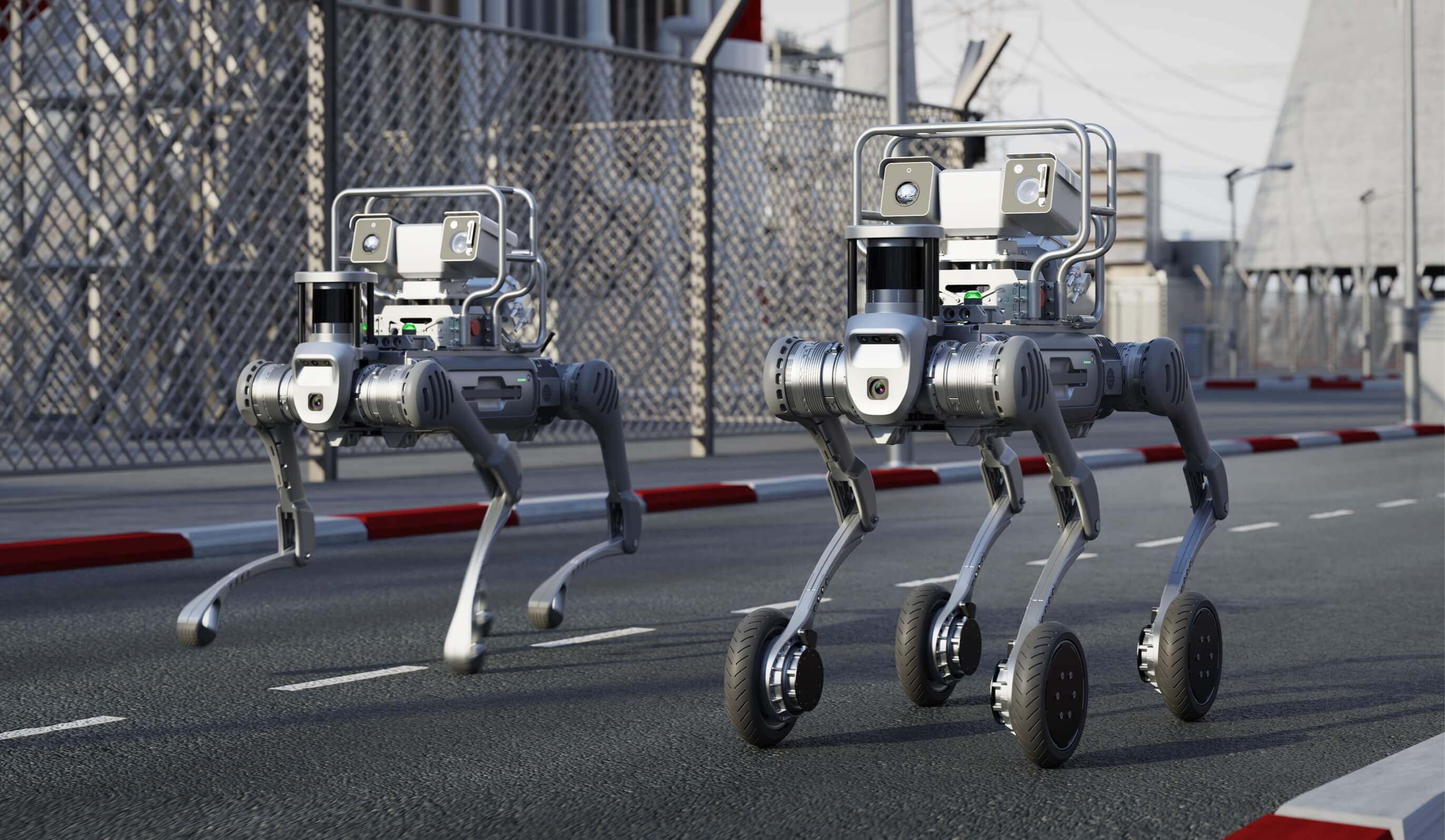
Key Specifications:
- Top Speed: >6 m/s (over 21 km/h)
- Peak Joint Torque: ~95 N·m
- Weight: ~25 kg (with battery)
- Payload: Static 150 kg; continuous walking ~16 kg
- Obstacle Climbing: 80 cm steps, 45° slopes
- Battery: 648 Wh (15,000 mAh)
- Endurance: Unloaded 3h+ (>33 km); loaded >2h (>16 km)
📊 As2-W Technical Highlights
Feature Spec Impact Wheel + Leg Hybrid 7” oversized wheels + legged articulation Flat-ground speed + terrain adaptivity ISS 3.0 Side-follow Centimeter-level positioning, stable tracking Autonomous load carrying IP54 Rating Dust & water resistant All-weather outdoor operation 150 TOPS Module On-device edge AI processing Real-time inspection, security Open Platform Full SDK + API access Embodied AI integration
Developer Ecosystem: The As2-W ships with comprehensive SDK and API support, compatible with large AI models for embodied intelligence and autonomous decision-making. Unitree continues its “open platform” strategy that has differentiated it from Boston Dynamics’ more closed approach.
🔗 Unitree As2-W Official Page | HN Discussion
2. 🏭 Nvidia Signs $500B Texas Data Center Lease: A City-Sized Compute Cluster
One-liner: Nvidia has signed a lease valued at up to $500 billion for a 1 GW data center campus in Texas being built by developer Hut 8, deploying hundreds of thousands of its GPUs in what is believed to be the largest single data center deal in history.
💡 Why It Matters: This deal signals Nvidia’s fundamental transition from chip supplier to “AI infrastructure-as-a-service” provider. The $500 billion figure — larger than the market cap of most public companies — underscores the sheer scale of the AI arms race. Nvidia is no longer just selling processors; it’s selling entire compute ecosystems.
Deal Details:
- Lease value: Up to $500 billion
- Campus capacity: 1 GW compute power
- Location: Texas
- Developer: Hut 8
- Deployment: Hundreds of thousands of Nvidia GPUs
📌 Industry Signal: Nvidia’s shift from “selling shovels” to “renting out the entire mine” represents a strategic evolution. For enterprise customers, this means access to GPU compute without the massive upfront capex. For Nvidia, it means deeper lock-in and recurring revenue — but also takes on balance sheet risk if AI demand softens.
🔗 Sina Finance | 36Kr
3. 🍎 Apple’s AI Smart Home Offensive: Siri AI Hub to Lead Product Family
One-liner: Apple is preparing a multi-product smart home push centered on a new Siri AI-powered home hub device, alongside a new Apple TV and an upgraded HomePod mini — marking the company’s most aggressive move into the smart home market.
💡 Why It Matters: Apple has been a laggard in the smart home space for years. The AI-powered home hub represents a belated but potentially disruptive entry — if Siri AI’s on-device inference is compelling enough, it could redefine the smart home entry point much like the iPhone redefined the smartphone.
Product Roadmap:
- Siri AI Home Hub: Central control device powered by next-gen Siri AI, expected Oct 2026 – early 2027
- New Apple TV: Fall 2026 refresh
- Upgraded HomePod mini: Fall 2026 release
📌 Robotics Angle: Apple’s home hub strategy mirrors the broader industry shift toward on-device AI processing. The same trend is driving the 150 TOPS edge module on Unitree’s As2-W — AI inference is moving from cloud to edge, whether in a home hub or a robot chassis.
4. 💰 DeepSeek Pauses Fundraise After Internal Compute Gap Leak
One-liner: DeepSeek has paused its latest fundraising round following the leak of an internal meeting recording in which executives candidly discussed the compute infrastructure gap between China and the US.
⚠️ Worth Watching: DeepSeek has been the poster child for “China’s AI efficiency narrative” — doing more with less compute. This leak reveals a more complex reality: even the most efficient Chinese AI labs feel the compute squeeze. The pause in fundraising amid rising geopolitical uncertainty could signal a broader reassessment of Chinese AI startup valuations.
5. 📊 Chip Market Divergence: AI Sell-Off vs Chinese Chipmaker Surge
One-liner: Semiconductor markets are experiencing a rare split — US AI chip stocks are selling off on AI bubble concerns while Chinese chipmaker shares have surged 470%, driven by domestic substitution expectations.
💡 Why It Matters: This divergence reflects two fundamentally different market narratives. The US market is asking “is AI CapEx sustainable?” while the Chinese market is driven by “must be self-sufficient.” Both narratives have merit, but they create a volatile cross-current for global semiconductor investors. For robotics companies, this means component costs and supply chains may face divergent pressures in 2026-2027.
🔗 HN Discussion: Chinese chipmaker shares surge 470% | HN Discussion: Chip stocks tumble
6. 🕶️ DEF CON Bans Meta Smart Glasses: Privacy Battle Reaches Hacker Conference
One-liner: DEF CON, the world’s largest hacker conference, has explicitly banned Meta’s camera-equipped smart glasses from its venue, extending its long-standing anti-surveillance stance to wearable recording devices.
📌 The Bottom Line: Meta positions its smart glasses as “augmented reality devices,” but to the security and privacy community, any unauthorized recording device is a surveillance tool. This ban highlights the growing tension between wearable camera technology and social acceptance — just because you can build it doesn’t mean society is ready for it. Expect more venues to follow DEF CON’s lead.
🔍 Weekly Trend Watch
Several threads this week point to a common theme: the AI industry’s competitive focus is shifting from “who can build the biggest model” to “who can build the most practical system.” Unitree’s As2-W isn’t the most powerful quadruped on paper — it’s the most balanced for real-world deployment. Nvidia’s $500B lease isn’t the most aggressive chip plan — it’s the most pragmatic infrastructure investment. Apple’s Siri AI hub isn’t the most cutting-edge AI product — it’s the most consumer-accessible AI entry point.
The industry is moving from “arms race” to “real-world deployment.” At this stage, productization and engineering excellence may matter more than raw model capability.
Sources: Unitree Robotics, 36Kr, Sina Finance, CLS, Hacker News, The Verge
This Daily Pulse is produced by the SinoBot editorial team | 中文版已同步发布 | Dual-polish pending